

How Are Companies Using MES Making a Difference? Real-Life Examples
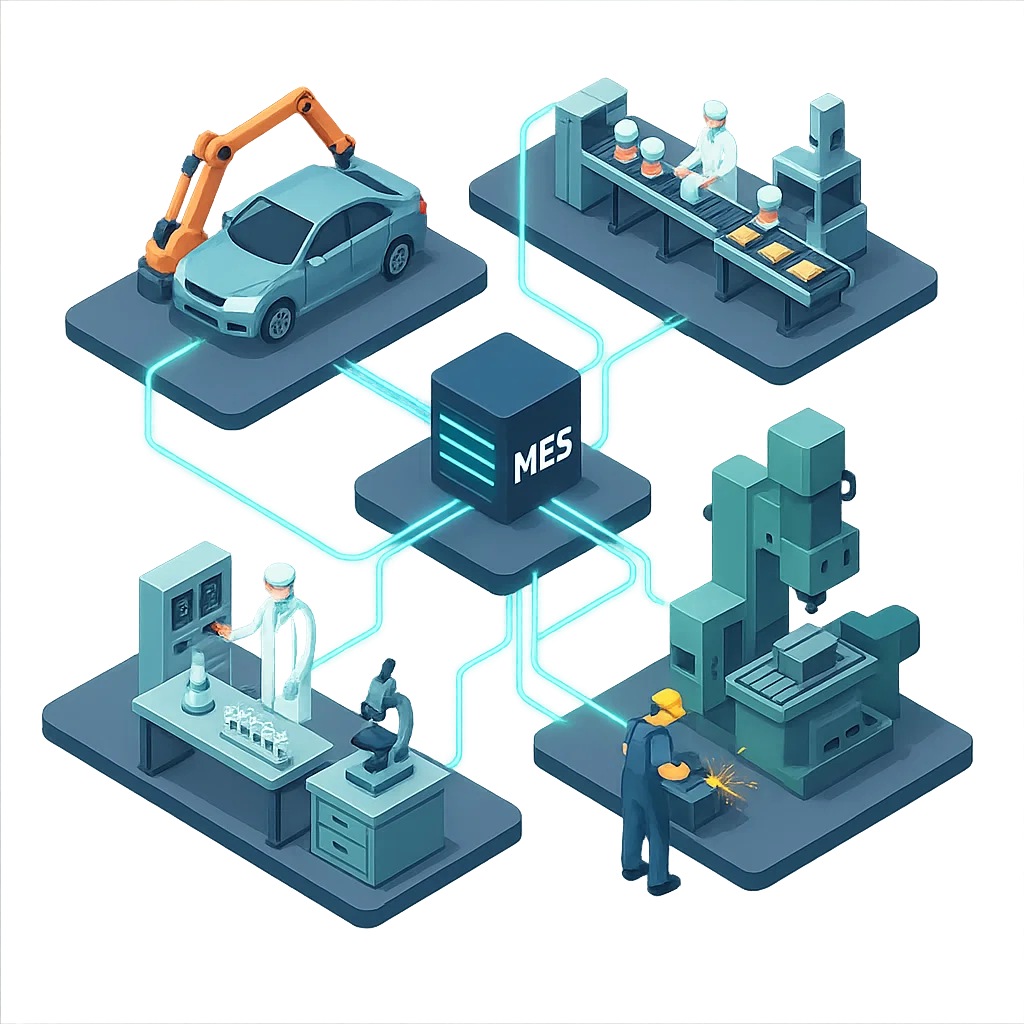
This is where Manufacturing Execution Systems (MES) come into play.
Companies using MES collect production data instantly, speeding up decision-making, improving quality and reducing costs. In this article, we will examine how MES systems make a difference for businesses and how this difference turns into concrete results through real-life examples.
1. Transparency in Production: Seeing Problems Instantly
Automotive Supplier Company
A mid-sized automotive supplier struggled to find the causes of downtime on its production line, and because data was kept manually, different reports emerged on every shift.
After MES integration:
- Data from every machine and operator is transferred to the system instantly.
- Downtime causes are classified automatically.
- The production manager can see within minutes which line is running inefficiently.
Result: An 18% increase in production efficiency and 12% fewer unplanned stoppages are achieved.
2. Consistency in Quality Management: A Drop in the Defective Product Rate
Food Production Facility
A food manufacturer that struggled to monitor quality deviations because it produces in batches, after the MES system was put into operation:
- Sample test results are entered into the system instantly.
- Automatic alerts are defined for out-of-limit values.
- Operators start filling out quality control forms digitally.
Result: The defective product rate falls from 9% to 3%.
3. Cost Advantage with Planned Maintenance: Downtime Decreased
Metal Processing Factory
A metal processing facility with a heavily used machine park that could not meet monthly production targets due to frequent breakdowns, after activating the maintenance management module together with the MES system:
- A maintenance plan based on operating hours is created for each machine.
- MES analyzes failure history and suggests "preventive maintenance" timings.
Result: Unplanned stoppages decreased by 25% and maintenance costs fell by 15%.
4. Traceability: Reducing the Risk of Recalls
Pharmaceutical Manufacturer
In the pharmaceutical industry, every batch must be recorded with all steps of the production process. With the MES system:
- Every operation, from raw material intake to packaging, is recorded digitally.
- Which operator worked on which machine at what time becomes traceable.
Result: Recall times during regulatory inspections fall from 4 days to 6 hours.
5. Data-Driven Decision-Making: Real-Time Reporting
Electronics Manufacturer
An electronics manufacturer that could not do daily planning because data sent to the ERP system was delayed, after MES integration:
- Data is transferred directly from the production line to the ERP.
- Reporting time falls from hours to minutes.
- Production targets are optimized on a daily basis.
Result: Production planning errors decrease by 20%.
6. Common Gains of Companies Using MES
| Area | Difference Achieved |
|---|---|
| Efficiency | 10-25% increase |
| Defective Production | Up to 30% reduction |
| Maintenance Cost | 15-20% decrease |
| Delivery Time | Average 20% improvement |
| Customer Satisfaction | Significant increase (measurable loyalty) |
These results prove that MES systems are not just a technology investment but a strategic transformation tool.
Conclusion
For manufacturing companies, MES systems mean not "more production" but "smarter production". Thanks to real-time data tracking, quality management and traceability, companies gain both a cost advantage and customer trust.
Nimbo Yazılım fully digitalizes the production floor of businesses with MES and ERP integration solutions tailored to the manufacturing sector.
Businesses empowered by real-time data manage not only today but also the future.
Have a question about something you read?
We are happy to talk it through — no obligation. Request a demo or ask for pricing and our team will get back to you shortly.