

What Is a Manufacturing Execution System (MES)? Key Components and Benefits
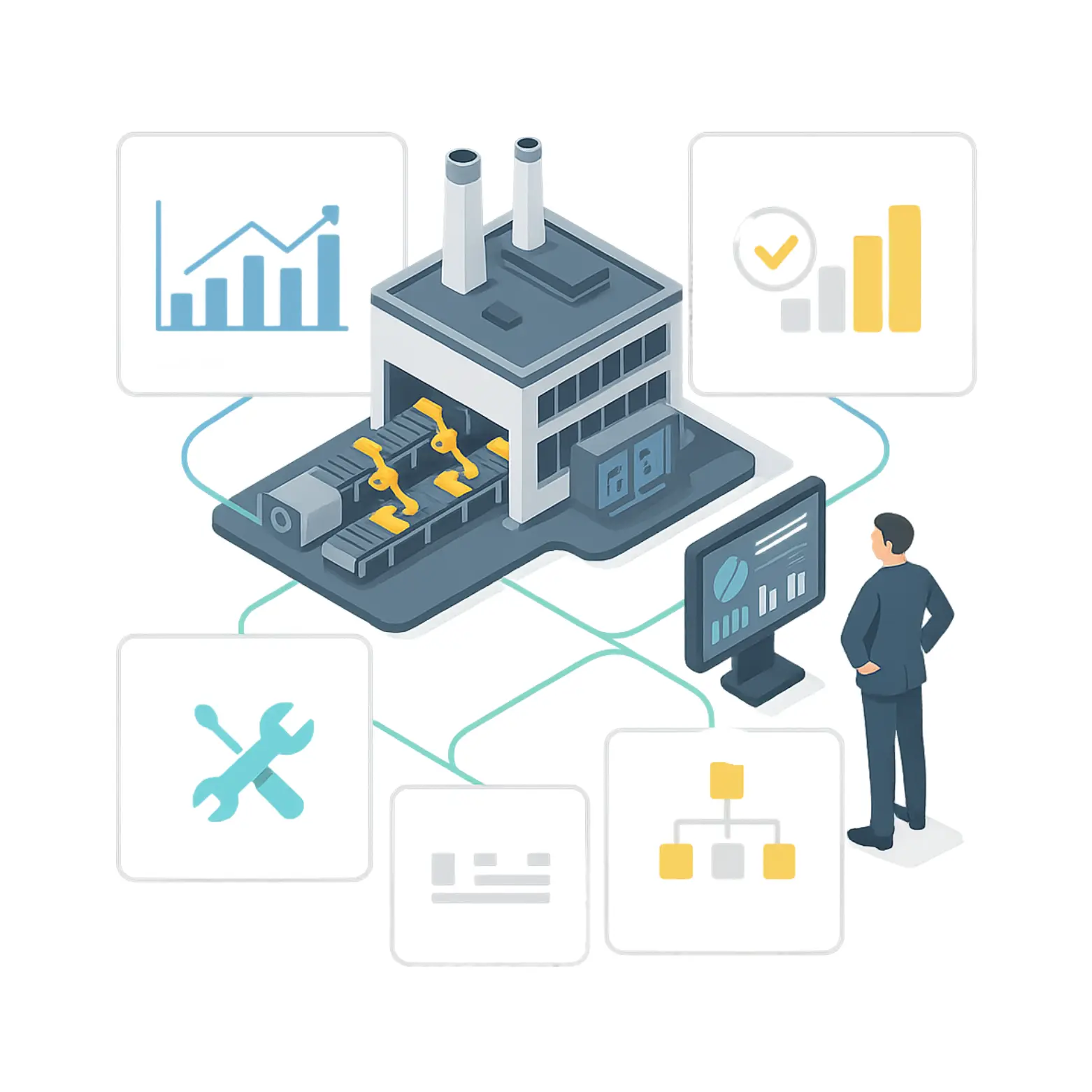
As competition in the manufacturing sector grows every day, businesses' success depends not only on production volume but also on their ability to deliver efficiency, quality and real-time control. At this point, the Manufacturing Execution System (MES) stands out as a digital infrastructure that monitors, manages and optimizes production processes end to end.
By monitoring every step on the shop floor instantly, MES lets companies see the difference between "planned production" and "actual production".
In short:
MES makes the invisible in production visible.
What Is MES?
The Manufacturing Execution System (MES) is a software system that monitors, manages and reports in real time every stage of the production process - from raw material intake to final product output.
While an ERP (Enterprise Resource Planning) system mostly manages macro processes such as finance, stock, accounting and planning, MES sits at the very heart of the shop floor.
In a simple definition:
If ERP is the "brain" of the factory, MES is its "nervous system".
Key Components of MES
1. Production Tracking Module
Provides instant tracking of the machines, operators and shift status on each production line.
- Production order status
- Machine downtime
- Operator performance
MES solutions collect all data from the production line in a single panel and offer real-time visibility.
2. Quality Management
MES continuously monitors quality measurements during production and generates an alert when there is a deviation from the set standards.
- Measurement records
- Sample test results
- Defective product rate analysis
Thanks to this module, quality problems are noticed immediately, not at the end of the process.
3. Maintenance Management
Machine failures are among the biggest causes of production loss. MES monitors equipment operating hours and enables planned maintenance.
- Preventive maintenance planning
- Failure records
- Energy and performance reports
This way, unplanned stoppages are minimized and maintenance costs go down.
4. Traceability
MES records every raw material and semi-finished product used in production, making the entire production journey of the product traceable.
This feature is a legal requirement, especially in sectors such as food, pharmaceuticals and automotive.
5. Data Collection and Analysis
MES systems collect real-time data from sensors, PLCs and machines. This data is analyzed to measure production performance and provide decision support.
By analyzing the data collected from production, it provides managers with reports that increase decision-making speed.
Benefits of Using MES for Companies
Real-Time Visibility
At what stage production is, which machine has stopped, or which operator is on duty can be monitored instantly.
Increased Efficiency
With MES, bottlenecks are easily identified. Unnecessary stoppages and resource waste are reduced.
Quality Assurance
With real-time quality checks, the defective production rate decreases and customer satisfaction increases.
Cost Reduction
Maintenance, raw material, energy and labor costs are optimized.
Management Decision Support
Senior management can evaluate production performance based on data.
Compliance with e-Transformation
MES systems work in harmony with e-Invoice, e-Waybill and ERP integrations, making legal obligations easier to meet.
MES and ERP: Stronger Together
MES collects real-time data on the production line. ERP uses this data to optimize planning, cost and stock management.
MES -> Manages production, ERP -> plans resources.
Nimbo ERP + MES integration gives businesses full control from production to management.
This way, efficiency increases while decision processes speed up.
In Which Sectors Is MES Used?
MES systems can be adapted to any production model, but they play a critical role especially in the following sectors:
- Automotive: Parts production, quality control and traceability.
- Food & Beverage: Batch-based production tracking, hygiene standards.
- Machinery & Metal: Energy efficiency, production planning.
- Chemicals & Pharmaceuticals: Formula tracking, safety processes.
Conclusion
Manufacturing Execution Systems (MES) are the digital backbone of modern production. Thanks to real-time data tracking, quality management and automation, they bring businesses efficiency, flexibility and speed.
Nimbo Yazılım makes the production floor of businesses visible, measurable and manageable with MES + ERP integration solutions tailored to the manufacturing sector.
Have a question about something you read?
We are happy to talk it through — no obligation. Request a demo or ask for pricing and our team will get back to you shortly.